
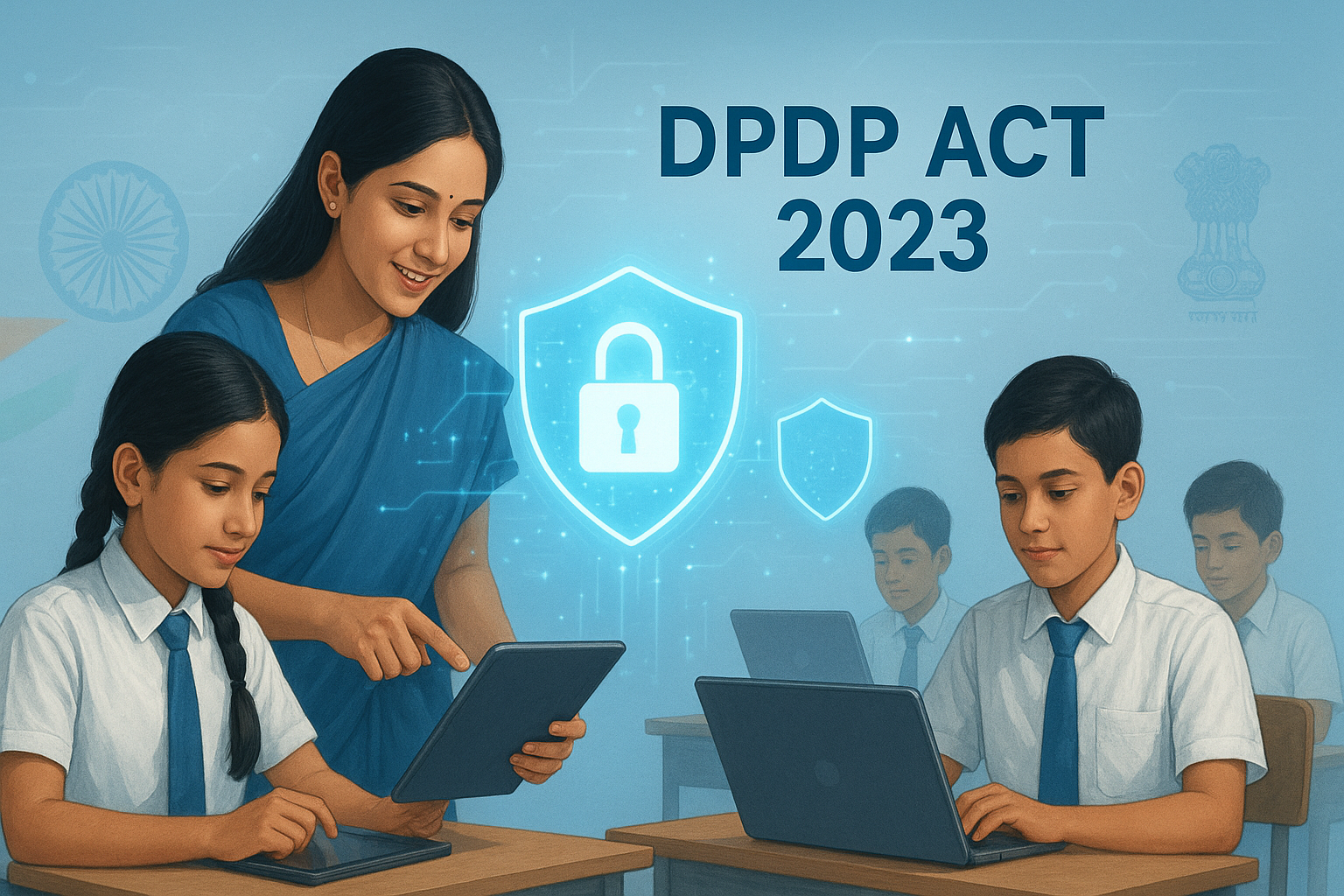
The Digital Personal Data Protection (DPDP) Act, 2023 is a landmark law that governs how personal data is collected, stored, and processed in India.
While most discussions focus on businesses and tech companies, schools, colleges, and universities are equally bound by this law because they handle vast amounts of students’ and parents’ personal data every day.
This blog explains how the DPDP Act applies to educational institutions and what schools need to do to stay compliant.
1. Why Schools Come Under the DPDP Act
Under the Act, any entity that collects or processes personal data digitally is covered, regardless of whether it is a company, NGO, or educational institution.
Schools regularly collect:
- Students’ names, addresses, phone numbers, Aadhaar numbers
- Academic records and attendance
- Parents’ contact and financial details
- Health records, photos, and CCTV footage
Hence, schools are Data Fiduciaries under the DPDP Act, responsible for protecting this information.
2. Key Responsibilities of Schools under the Act
a) Obtain Proper Consent
Schools must take verifiable consent from parents or guardians before collecting and processing any child’s data.
For children under 18, consent cannot be directly obtained from the child.
Consent forms should clearly state:
- What data is being collected
- Why it is needed
- How long it will be retained
- How parents can withdraw consent
b) Handle Children’s Data with Extra Care
Section 9 of the Act imposes additional obligations for processing children’s data.
Schools must ensure that:
- No tracking, monitoring, or behavioral profiling of students takes place.
- No targeted advertising or data sharing without parental approval.
- All digital tools used (apps, online learning platforms, etc.) follow the same rules.
c) Securely Store and Transmit Data
Under Section 8(5), schools must implement reasonable security safeguards to prevent unauthorized access, data breaches, or misuse.
Examples include:
- Using password-protected databases
- Restricting data access to authorized staff
- Encrypting sensitive files
- Ensuring vendor compliance (e.g., ERP software, cloud storage, payment systems)
d) Notify Authorities and Parents in Case of Breach
If a school experiences a data breach (for example, leaking of student records), it must inform both:
- The Data Protection Board of India, and
- The affected individuals (parents/students)
Failure to do so can attract penalties of up to ₹250 crore.
e) Delete Data When No Longer Needed
The DPDP Act requires schools to erase personal data once its purpose is served, for example, when a student graduates or transfers out.
This ensures data isn’t kept indefinitely, reducing the risk of misuse.
3. Common Data Protection Mistakes Schools Make
- Collecting unnecessary personal details on admission forms
- Sharing student data with third parties (like photographers or vendors) without consent
- Using unsecured WhatsApp groups to share student information
- Keeping old student records indefinitely
- Ignoring data security measures for staff devices
4. How Schools Can Start DPDP Compliance
Here’s a simple 5-step approach:
- Data Mapping: Identify all data collected (admissions, fees, attendance, etc.).
- Review Consent Forms: Redesign them as per DPDP requirements.
- Train Staff: Conduct awareness sessions on data privacy.
- Secure IT Systems: Work with vendors to ensure data encryption and access control.
- Appoint a Compliance Officer: Assign someone to oversee DPDP implementation.
5. Penalties for Non-Compliance
If a school fails to comply with the DPDP Act:
- Data breach or lack of safeguards: Up to ₹250 crore
- Failure to protect children’s data: Up to ₹200 crore
- Breach of consent obligations: Up to ₹50 crore
Even though such penalties target “Data Fiduciaries,” schools can be held liable for negligence if adequate safeguards aren’t in place.
Conclusion
The DPDP Act, 2023 brings Indian education into the digital privacy era.
For schools, compliance isn’t just a legal formality, it’s about protecting children’s trust and digital safety.
By adopting responsible data practices, schools can not only avoid penalties but also demonstrate leadership in ethical data management.
FAQs
1. Does the DPDP Act apply to private as well as government schools?
Yes, both private and public educational institutions that handle digital data are covered.
2. What should schools do first to start compliance?
Begin with a data audit, identify what personal data you collect, where it’s stored, and who can access it.
3. Are schools required to appoint a Data Protection Officer (DPO)?
Only if designated as a Significant Data Fiduciary by the Government. However, having a privacy officer is good practice.
4. Can schools share student data with third-party apps or service providers?
Only with verified parental consent and after ensuring those vendors follow DPDP standards.