
India’s evolving data protection environment has triggered a noticeable shift in institutional conversations around privacy. Across boardrooms, compliance teams, legal departments and operational leadership functions, the discussion is gradually moving beyond awareness of the Digital Personal Data Protection framework toward a more difficult and practical question:
What does meaningful operational readiness actually look like?
For many organisations, particularly in sectors such as education, healthcare and hospitality, the challenge is not merely understanding legal obligations. The larger challenge lies in translating privacy expectations into operational reality across people, systems, processes, vendors and institutional culture.
This is where the concept of DPDP operational readiness becomes significantly more important than checklist-driven compliance conversations.
Operational readiness is not about claiming perfect compliance. It is about whether an institution is structurally capable of governing personal data responsibly, consistently and sustainably within the realities of day-to-day operations.
For institutions managing large volumes of sensitive personal interactions, this distinction matters enormously.
Moving Beyond Policy-Centric Privacy Discussions
One of the most common misconceptions surrounding data protection compliance is the assumption that privacy can be addressed primarily through documentation.
Policies, notices, consent language and contractual clauses are important components of governance. However, operational maturity cannot be achieved through documentation alone.
In practice, most institutional privacy failures emerge from operational disconnects rather than absence of policies.
Examples often include:
- Consent collected inconsistently across departments
- Personal data shared informally through unmanaged communication channels
- Vendors handling data without structured oversight
- Employees lacking clarity on permissible data use
- Delayed breach escalation pathways
- Undefined ownership of privacy responsibilities
- Legacy systems processing personal data without governance visibility
This is why DPDP operational readiness should be viewed as an organisational capability framework rather than a purely legal exercise.
The question is no longer:
“Do we have a privacy policy?”
The more important question is:
“Can our institution operationally govern personal data in a controlled, accountable and sustainable manner?”
Understanding DPDP Operational Readiness in Practical Terms
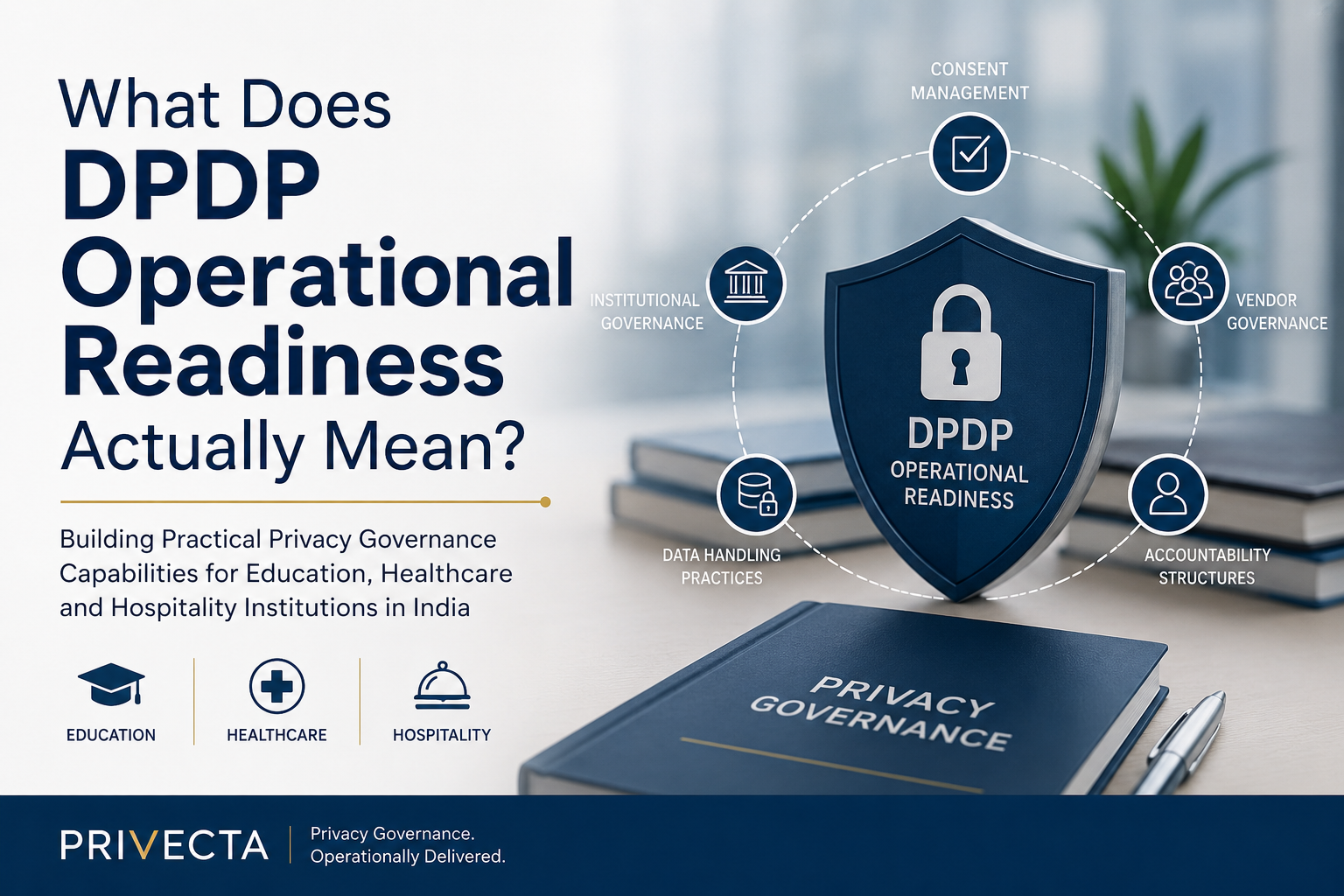
At its core, DPDP operational readiness refers to an institution’s ability to operationalise privacy obligations across its actual business environment.
This includes readiness across:
- Governance structures
- Institutional accountability
- Consent management practices
- Data handling workflows
- Vendor governance mechanisms
- Rights handling processes
- Incident response coordination
- Internal awareness and training
- Documentation discipline
- Leadership oversight
Importantly, operational readiness is not a one-time certification exercise.
It is an ongoing governance capability.
Much like financial governance or operational risk management, privacy governance requires institutions to establish repeatable internal structures capable of adapting as technologies, vendors, regulations and institutional processes evolve.
For many Indian organisations, especially those outside heavily regulated technology sectors, this represents a significant organisational transition.
Why Operational Readiness Matters More Than Theoretical Compliance
As privacy discussions mature in India, institutions are increasingly recognising that theoretical compliance narratives offer limited protection if operational execution remains fragmented.
This is particularly relevant in sectors where personal data interactions occur continuously and at scale.
A hospital may maintain formal privacy notices while operationally allowing uncontrolled sharing of patient information across messaging platforms.
An educational institution may publish consent language while multiple departments independently collect and process student data without governance alignment.
A hospitality business may outsource critical customer-facing functions without adequate vendor governance visibility.
In each of these scenarios, the operational gap becomes more important than the existence of formal documents.
Operational readiness therefore becomes a question of institutional resilience.
Can the organisation demonstrate:
- Accountability structures?
- Responsible data handling culture?
- Coordinated governance processes?
- Clear escalation mechanisms?
- Operational awareness of privacy obligations?
- Leadership involvement in governance oversight?
These factors increasingly shape institutional credibility and digital trust.
Privacy Governance Is Becoming an Institutional Leadership Issue
One of the most important developments in modern privacy governance is the gradual movement of privacy discussions from isolated legal functions toward enterprise-level governance conversations.
This shift is important.
Privacy governance today intersects with:
- Institutional reputation
- Digital trust
- Vendor ecosystems
- Operational continuity
- Technology governance
- Customer confidence
- Student and patient trust
- Risk management
- Investor and partnership due diligence
As a result, DPDP operational readiness cannot remain siloed within legal or IT departments alone.
Institutional leadership increasingly needs visibility into:
- How personal data flows across the organisation
- Which vendors process institutional data
- How consent dependencies are operationalised
- Whether governance responsibilities are clearly assigned
- How incidents are escalated internally
- Whether operational teams understand acceptable data practices
This does not mean every institution requires highly complex privacy infrastructure from the outset.
However, it does require governance intentionality.
Organisations that approach privacy purely as a documentation exercise may eventually struggle with operational inconsistencies that become difficult to manage at scale.
The Operational Complexity of Consent Management
Consent management is often discussed at a surface level, yet operationally it is one of the most complex aspects of privacy governance.
The challenge is rarely limited to obtaining consent.
The real challenge lies in operational consistency.
Institutions must evaluate questions such as:
- Where exactly is consent being collected?
- Is consent language standardised across departments?
- Are offline and digital consent practices aligned?
- Can consent records be demonstrated if required?
- Are consent withdrawals operationally manageable?
- Are third-party systems processing data consistently with institutional consent frameworks?
In sectors like healthcare and education, consent interactions frequently occur through multiple operational channels including websites, admission forms, patient registration systems, applications, support interactions and vendor-managed platforms.
Without governance coordination, institutions can unintentionally create fragmented consent ecosystems.
Operational readiness therefore requires institutions to view consent not merely as a form or checkbox, but as an operational governance process.
Vendor Governance Is Emerging as a Critical Readiness Area
Modern institutions increasingly rely on external service providers for technology, analytics, cloud infrastructure, admissions management, CRM systems, communication tools and operational outsourcing.
As a result, vendor governance is becoming central to institutional privacy maturity.
Many organisations underestimate how extensively third-party ecosystems interact with personal data.
A school may use multiple SaaS platforms for admissions, learning management and communication.
A hospital may depend on external diagnostic systems, appointment platforms and cloud-based record management.
A hospitality business may integrate booking systems, marketing platforms and guest engagement technologies from various providers.
Operational readiness therefore requires visibility beyond internal systems alone.
Institutions should gradually develop governance capabilities around:
- Vendor data handling visibility
- Contractual accountability
- Third-party risk assessment
- Data sharing oversight
- Access management
- Incident coordination responsibilities
Importantly, vendor governance is not about creating adversarial vendor relationships.
It is about ensuring governance alignment within increasingly interconnected operational ecosystems.
Sector-Specific Operational Readiness Considerations
Education Sector
Educational institutions often manage personal data across highly decentralised operational environments.
Admissions teams, academic departments, examination cells, hostel administration, alumni functions and third-party education platforms may all interact with student and parent data independently.
Operational readiness challenges frequently include:
- Fragmented data collection practices
- Informal communication channels
- Limited vendor visibility
- Legacy administrative systems
- Inconsistent consent mechanisms
- Distributed operational ownership
Privacy governance in education therefore requires institutional coordination rather than isolated departmental initiatives.
Healthcare Sector
Healthcare organisations face particularly sensitive operational privacy considerations due to the nature of patient information and the complexity of healthcare ecosystems.
Operational realities often involve:
- Multiple care delivery touchpoints
- Third-party diagnostic integrations
- Insurance coordination
- Emergency data sharing scenarios
- Clinical workflow pressures
- Legacy health information systems
In healthcare environments, privacy governance must balance operational practicality with governance discipline.
Overly theoretical compliance models often fail because they do not adequately reflect clinical realities.
Operational readiness in healthcare therefore requires governance frameworks that are practical, scalable and operationally grounded.
Hospitality Sector
Hospitality businesses increasingly operate through digitally connected customer engagement ecosystems.
Guest data may flow across:
- Booking platforms
- Loyalty systems
- Marketing automation tools
- Customer support systems
- Payment environments
- Third-party travel integrations
The challenge is not simply collecting customer data responsibly, but maintaining governance visibility across interconnected operational systems.
As customer trust becomes increasingly linked to digital experience quality, privacy governance may gradually become part of broader brand trust positioning within the hospitality sector.
Operational Readiness Is Ultimately About Governance Maturity
Perhaps the most important point institutions should recognise is that DPDP operational readiness is not about achieving a static “fully compliant” status.
Privacy governance maturity develops progressively.
Institutions typically evolve through stages:
- Awareness-driven discussions
- Policy-focused implementation
- Operational alignment efforts
- Governance integration
- Institutional privacy maturity
The objective should not be perfection at the outset.
The objective should be establishing credible governance direction, operational accountability and sustainable privacy management capabilities.
Organisations that approach privacy governance strategically often gain advantages beyond regulatory preparedness alone.
They strengthen:
- Institutional trust
- Operational discipline
- Governance credibility
- Leadership visibility
- Vendor accountability
- Risk awareness
- Digital maturity
In many ways, operational privacy readiness is becoming a broader indicator of institutional governance maturity itself.
A Strategic Perspective on the Road Ahead
As India’s privacy landscape continues evolving, institutions will likely face increasing pressure to demonstrate not only legal awareness, but operational governance capability.
This transition will require organisations to move beyond narrow compliance checklists and toward integrated privacy governance thinking.
The institutions that navigate this transition effectively are unlikely to be those making the loudest compliance claims.
Instead, they will likely be the organisations quietly building structured governance foundations, operational accountability mechanisms and sustainable institutional readiness.
DPDP operational readiness is therefore not merely a regulatory exercise.
It is a long-term governance discipline.
And increasingly, it may become an important marker of institutional trust, operational maturity and leadership responsibility in India’s evolving digital ecosystem.